WiFi 6E. 6GHz Clean Lane.
PCMag Editors' Choice 2025.
The new 6 GHz band — zero interference, zero legacy congestion — exclusive to WiFi 6E devices. Up to 5400 Mbps tri-band. 1.7 GHz quad-core CPU + 512 MB RAM. 160 MHz channels. OneMesh expansion. VPN + WPA3. Supports 200+ devices.
WiFi 6E at a Price Point That
Finally Makes Sense.
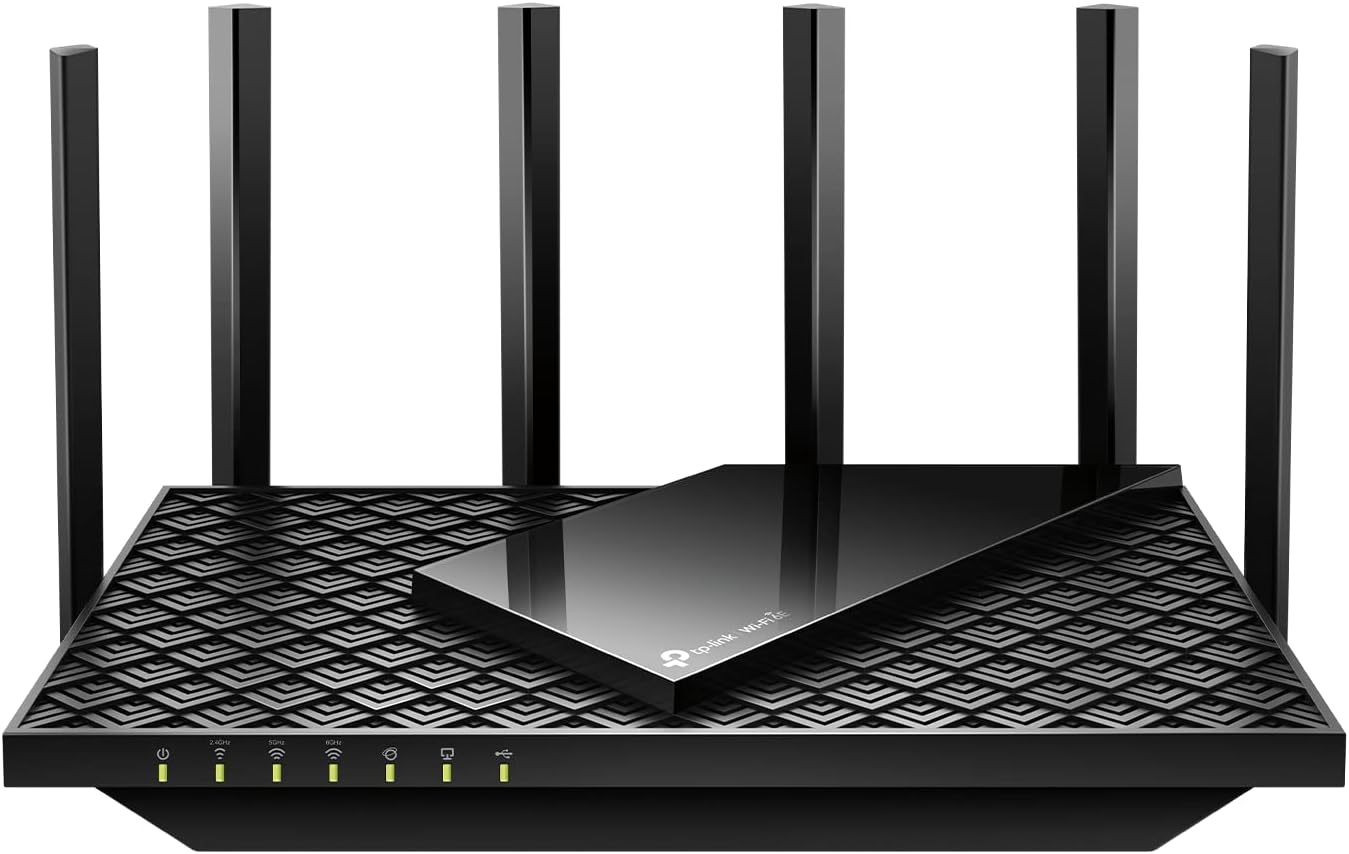
WiFi 6E's defining feature — the 6 GHz band — was initially available only in premium routers costing $300 and above. The TP-Link Archer AXE75 changed that equation: it delivered genuine tri-band WiFi 6E with a dedicated 6 GHz band at a price point well below the market's established WiFi 6E floor. That combination earned it PCMag's Editors' Choice award in 2025, and it remains one of the most validated entry points into WiFi 6E networking.
The core value proposition is the 6 GHz band itself — a completely new wireless spectrum with no legacy device interference, no neighbour network congestion, and 160 MHz channels available across the full band. Combined with a 1.7 GHz quad-core CPU and 512 MB of RAM handling intensive multi-device traffic efficiently, OFDMA technology expanding device capacity four-fold, and OneMesh whole-home expansion capability — the AXE75 delivers a meaningful real-world upgrade from any WiFi 5 or WiFi 6 router for homes with 6 GHz-capable devices.
PC Gamer's reviewer noted that WiFi 6E routers offer "a lot of extra capacity over previous versions" and the AXE75 does so "without paying the price premium of the new hotness" — a directly relevant point as WiFi 7 prices remain elevated. Dong Knows Tech confirmed the AXE75 as "an excellent buy" at its price for those needing a standalone router for sub-Gigabit broadband. Mini PC Reviewer called the quad-core CPU and OFDMA combination "sustained multi-device performance and low latency under load." The 2025 PCMag Editors' Choice recognition validates the ongoing relevance of the AXE75 even in an era of WiFi 7 availability.
View on Amazon ↗Four Technologies That Explain
Why This Earned PCMag's Top Award.
The AXE75's PCMag Editors' Choice recognition reflects four specific technical advantages that translate directly into real-world network performance improvements.
The 6 GHz Band — A Clean Wireless Highway With No Traffic
WiFi has always shared spectrum with other devices: the 2.4 GHz band is shared with microwaves, baby monitors, Bluetooth, and neighbouring networks. The 5 GHz band is better but still crowded in urban environments. The 6 GHz band was opened exclusively for WiFi 6E — no legacy devices can access it, no other technology uses it, and in most environments there are zero competing networks. PC Gamer's reviewer describes this as giving you "additional 160 MHz channels to play with" — up to seven non-overlapping 160 MHz channels exclusively for WiFi 6E devices. For a gaming PC or WiFi 6E laptop in the same room as the router, the 6 GHz band delivers peak performance with zero congestion regardless of what the rest of the household is doing on 5 GHz and 2.4 GHz. The AXE75's 6 GHz radio delivers 2402 Mbps on this clean band.
Quad-Core 1.7GHz CPU + 512MB RAM — Performance Under Load
Router performance degradation under load — when multiple devices are simultaneously streaming, gaming, and downloading — is almost always a processing and memory bottleneck, not a wireless bottleneck. The AXE75's 1.7 GHz quad-core processor and 512 MB of high-speed memory handle intensive multi-device traffic without the queue buildup that causes latency spikes in underpowered routers. Mini PC Reviewer specifically validates this: "1.7 GHz quad-core CPU and 512 MB RAM deliver sustained multi-device performance and low latency under load." For competitive gaming where latency consistency matters as much as average latency, the quad-core processing translates directly to more consistent ping times when the household network is under full load.
OFDMA + MU-MIMO — 4× More Device Capacity, Bidirectional
WiFi 5 served devices sequentially — each device had to wait its turn. WiFi 6 and 6E's OFDMA (Orthogonal Frequency Division Multiple Access) divides each channel into sub-channels, transmitting to multiple devices simultaneously within the same time slot. The AXE75 increases capacity four times through this technology, enabling the 200+ device specification. MU-MIMO (Multi-User Multiple Input Multiple Output) extends this to both upload and download directions simultaneously — PC Gamer's reviewer specifically highlights this improvement: "you'll get a boost in capacity for uploads as well as downloads, which is important for keeping latency down when gaming." This bidirectional MU-MIMO is a WiFi 6/6E-specific improvement over the download-only MU-MIMO of WiFi 5.
WPA3 + VPN Server/Client — Modern Security Built In
WPA3 is the current state-of-the-art WiFi security standard, providing stronger encryption and protection against offline brute-force attacks compared to WPA2. The AXE75 supports both WPA3 and WPA2 for backward compatibility. VPN support extends to both server and client modes: as a VPN client, the router routes all network devices through your chosen VPN service without per-device app installation; as a VPN server, it allows secure remote access to your home network from anywhere. Supported protocols: OpenVPN, PPTP, and L2TP. HomeShield provides additional real-time threat scanning, parental controls, and QoS with the free basic plan.
Four Households That Will
Feel the 6 GHz Difference.
The AXE75 delivers its most tangible improvements for four specific home network situations where the 6 GHz band and quad-core processing make a direct, measurable difference.
The 6 GHz band delivers its biggest advantage in gaming: a dedicated, interference-free channel that keeps latency consistent regardless of what else is happening on the 5 GHz network. Mini PC Reviewer specifically validates: "input lag drops noticeably compared with crowded 5 GHz setups, especially when other devices are active." The quad-core CPU ensures QoS prioritisation executes in real-time without processing lag during high-traffic periods.
Multiple simultaneous 4K streams from different family members is the exact workload OFDMA was designed for. The AXE75's four-fold capacity increase through OFDMA allows simultaneous transmission to multiple devices without the queue-and-wait model of WiFi 5. The 6 GHz band provides the dedicated high-bandwidth stream for the primary 8K or 4K device while 5 GHz handles the remaining streams without cross-band competition.
Smart speakers, thermostats, lights, cameras, locks, and appliances that would previously crowd the 2.4 GHz band can now be cleanly separated: 2.4 GHz for IoT and legacy devices (long range, low bandwidth), 5 GHz for phones, tablets, and laptops (medium bandwidth), and 6 GHz exclusively for the highest-demand devices. This band separation is WiFi 6E's architecture-level solution to IoT congestion.
WiFi 7 routers command significant price premiums for features that require WiFi 7 client devices to utilise. For households without WiFi 7-capable devices, the AXE75 delivers genuine WiFi 6E — the real, meaningful upgrade from WiFi 5 or WiFi 6 — at a price significantly below both WiFi 7 options and many premium WiFi 6E alternatives. This is precisely why PCMag awarded it Editors' Choice: maximum WiFi 6E capability at the best-value price.

Complete Technical
Details
| WiFi Standard | WiFi 6E (802.11ax) — backward compatible with all WiFi generations |
| Total Speed | AXE5400 — 5400 Mbps combined: 2402 (6 GHz) + 2402 (5 GHz) + 574 (2.4 GHz) Mbps |
| 6 GHz Band | 2402 Mbps · 160 MHz channels · WiFi 6E exclusive — zero legacy interference |
| 5 GHz Band | 2402 Mbps · 160 MHz |
| 2.4 GHz Band | 574 Mbps |
| WiFi 6E Features | OFDMA (4× capacity) · MU-MIMO (up+down) · 1024-QAM · HE160 · Target Wake Time |
| Processor | 1.7 GHz Quad-Core CPU |
| Memory | 512 MB high-speed RAM |
| WAN Port | 1× Gigabit + 1× 2.5 Gbps combo WAN/LAN port |
| LAN Ports | 4× Gigabit Ethernet |
| USB | 1× USB 3.0 Type-A — network storage sharing |
| Antennas | 6× high-gain external antennas + Beamforming |
| Device Capacity | 200+ devices (OFDMA) |
| Mesh | OneMesh compatible — expandable with TP-Link OneMesh extenders |
| VPN | Server + Client: OpenVPN · PPTP · L2TP |
| Security | WPA3 · WPA2 · HomeShield (free basic + paid Pro) |
| Management | TP-Link Tether app (iOS + Android) · Web UI · Alexa voice control |
| Award | 2025 PCMag Editors' Choice |
| Warranty | 2 years — 1 year more than most networking brands |
| Dimensions | 10.7 × 5.8 × 1.9 inches · 734g |
The Honest
Breakdown
We don't do paid reviews. This assessment draws on PC Gamer, Dong Knows Tech, Mini PC Reviewer, and verified Amazon buyer feedback.
- ✓2025 PCMag Editors' Choice — independently awarded for best WiFi 6E performance-to-value ratio in its price class
- ✓True 6 GHz WiFi 6E band — congestion-free, interference-free dedicated high-speed lane for WiFi 6E devices
- ✓1.7 GHz quad-core + 512 MB RAM — sustained low-latency performance under heavy multi-device load confirmed by independent reviewers
- ✓OFDMA 4× capacity + bidirectional MU-MIMO — handles 200+ devices without the queue bottleneck of WiFi 5
- ✓160 MHz channels on 6 GHz — maximum channel width for highest-throughput WiFi 6E connections
- ✓2.5G combo WAN/LAN port — ready for multi-gig ISP connections up to 2.5 Gbps
- ✓VPN server + client (OpenVPN/PPTP/L2TP) — router-level VPN for all network devices simultaneously
- ✓Best-value WiFi 6E entry point — consistently cited as the most cost-effective path to genuine WiFi 6E by multiple independent reviewers
- ✓2-year warranty — 1 year longer than most networking brands
- ✓Easy Tether app setup · Alexa voice control · USB 3.0 network storage
- —LAN ports are Gigabit only — no multi-gig LAN ports (unlike the BE550); if your wired devices need 2.5G LAN speed, the BE550 is the better choice
- —6 GHz has shorter range — higher frequency means less wall/floor penetration than 5 GHz; the clean 6 GHz band is most beneficial for devices in the same room or nearby
- —WiFi 6E benefits require WiFi 6E clients — the 6 GHz band is only accessible to WiFi 6E-capable devices; older devices use 5 GHz and 2.4 GHz as normal
- —OneMesh is basic mesh — similar to extender-based expansion; for true seamless whole-home mesh, TP-Link's Deco series is architecturally superior
- —HomeShield advanced features require subscription — basic security is free; parental controls and advanced threat protection at Pro tier are paid
- —No WiFi 7 — buyers who want future-proofing for MLO and 320 MHz channels should look at the BE550 (WiFi 7)
The Smart Upgrade for Anyone
Still on WiFi 5 or Early WiFi 6.
The AXE75 is the right router for anyone who wants a genuine, meaningful wireless upgrade at the best possible price — without paying WiFi 7 premiums for features they can't yet use.
The clean 6 GHz lane. PCMag Editors' Choice.
WiFi 6E without the premium price.
AXE5400 · TRI-BAND · 6GHz BAND · 160MHz · QUAD-CORE · 512MB RAM · WPA3 · VPN · ONEMESH · 200+ DEVICES · 2YR WARRANTY
Questions People
Actually Ask
The Best-Value WiFi 6E Router
for Gaming, Streaming & Smart Homes.
The TP-Link Archer AXE75 earns both our Editor's Pick and its 2025 PCMag Editors' Choice by delivering what the WiFi 6E category needed: all the technology that matters — the clean 6 GHz band, 160 MHz channels, OFDMA four-fold capacity, bidirectional MU-MIMO, and a quad-core processor with 512 MB RAM — at a price point that removed the budget barrier to WiFi 6E adoption. The Value score (9.3) is the highest on the page because it directly reflects the router's defining achievement. PC Gamer, Dong Knows Tech, and Mini PC Reviewer all converge on the same conclusion from different review angles: the AXE75 delivers where it matters, at a price that makes the decision straightforward.
The honest calibration: the LAN ports are Gigabit only — the BE550 (WiFi 7) is the better choice for multi-gig wired needs. The 6 GHz band's shorter range limits its benefit to near-the-router devices. WiFi 7's MLO is a genuine future capability the AXE75 doesn't support. And HomeShield's advanced features require a paid subscription. For anyone still on WiFi 5 or early WiFi 6 who wants the best available WiFi upgrade without paying WiFi 7 prices for technology their devices can't yet use — the AXE75 remains the PCMag Editors' Choice answer.